
Player Development

Player
Development Camps
Introduction
Welcome to the Bob Halkidis Development Camp. The focus of this camp is to help players improve their individual skills and maintain a certain level of conditioning through out the off season. All players will be tested using the "Dominoes Skills Challenge Test". This on ice test consists of six stations ranging from skating speed, agility, to passing and shooting accuracy. The beginning weeks we will focus on the mechanics of skating, passing, shooting, and stick handling. Initially, drills will be done at slower speeds in order for players to gain confidence. As we progress into the middle weeks of the camp the tempo of the drills will be increased. Toward the end, all drills and progressions will be at full tempo to prepare for the upcoming season.
Please keep in mind that in order for players to really learn and improve their
skills, they must be pushed outside of their comfort zone. Players will be
encouraged to skate harder and not to worry about falling or losing a puck in a
drill, remember; this is to improve each individual player's skill and is not a
tryout or a competition with other players on the ice.
Complex skills are most easily acquired a bit at a time. The suggested order
for teaching hockey skills is skating, puck control, passing and receiving,
shooting, checking. The progressions that we will be teaching are organized
from simple to complex.
Teaching Philosophy
The simplest way of describing how people learn is "I hear, I see, I do." Coaches apply this by explaining, demonstrating, and practicing a skill. By gathering information, making decisions on how to perform, practicing, and then evaluating the result or being provided an opinion about the result, an athlete can learn a skill. A coach must first evaluate every player's level of skill. Age, strength, maturity, and motivation are all influences on the learning capabilities of an Athlete.
Feedback
An athlete always needs to know how well they have performed a skill. Delayed
feedback is not the way to go, so we make sure that the athlete gets immediate
feedback. Although verbal feedback is wonderful, visual feedback is better for
beginners, while verbal is best and more effective for older more experienced
athletes. We give limited, specific feedback during the development process of
a skill, this makes sure that the athlete understands the feedback they are
receiving too.
Whole vs. Part
Complex skills should be seen in their entirety first, and then broken down into
parts so that they can easily be learned. If an athlete can find related
sections in each part of a whole skill, then it will make learning more
effective. An example of this is, teaching the hip check where each skill is
broken down and then practiced as these following elements, backward skating
and crouch, hip and body rotation, contact, and knee extension and upward
thrust. When timed coordination is required for these parts, we practice with
all of them together and in sequence. It is a whole lot better to practice a
skill as a whole.
Chaining
Chaining, what chaining means is to learn and connect the parts that make up a
complex skill. While learning a skill, the athlete learns to link the various
distinct parts of the skill. Forward Chaining means to learn a skill by
starting with the first part. An example of forward chaining in teaching the
slap shot is by teaching the back swing, then moving through the forward swing,
and finally the impact and follow-through stages. Backward Chaining means to
learn a skill be starting with the last part and then working your way
backwards. The skill will be practiced as a whole as soon as the parts of it
are linked together. An example of back chaining in teaching the slap shot is
by starting with the follow-through and moving back through the sequence.
Shaping
When the learning of a skill takes place gradually it is called Shaping. The
skill will be demonstrated then broken down into simpler form to include only
the most important parts. The missing parts will be added in gradually so that
the whole skill is learned. The way shaping differs from chaining is that the
athlete can start at any part of the skill and learn it where as in chaining you
have to start at either the beginning or end.
Imagery
Before mental practice (imagery) can be done an athlete needs some knowledge of
the skill. Mental rehearsal of a skill will be shown to help with the learning
process. We use mental practice and physical practice with each other before a
skill is about to be used and also at times away from practice.
Mass vs. Distributed Practice
Practice being massed or distributed is not as important as the total number of
trials or time for quality practice being given. The most believed superior
thing to do is the practicing a skill that is divided among a number of
practices rather than practicing a skill massed into one practice. When used
with the better skilled or more mature athlete massed practice may work in some
situations.
Grouping
Athletes tend to learn faster when grouped with others at their level of skill.
Lower skilled athletes learn faster when grouped in a mixed-skill group, while
higher skilled athletes would rather work with practice. When used with the
better skilled or more mature athlete massed practice may work in some
situations. Athletes tend to learn faster when grouped with others at their
level of skill. Lower skilled athletes learn faster when grouped in a
mixed-skill group, while higher skilled athletes would rather work with, and
also learn faster while practicing with the higher skilled group.
Environment
Well-planned, positive instruction with proper teaching aids and equipment
supports the learning process; also a well lit, clean, positive practice
environment can too.
Short-term Memory
Information stays with a learner between 20 and 30 seconds, so we teach only
three or four key points at a time. These are two reasons why an athlete needs
to practice the skill being taught immediately after the teaching process takes
place.
Teaching Process
Select the Skill
Step one in the process of teaching is to select the skill or skills to be
taught. The athletes' present skill level, age, physical maturity, and
motivation are important in deciding the skill progression. Skills should not
be too easy or too hard. Simple to complex progression is a must and have a
plan for that progression. Game-like yet challenging skills and drills should
always be used. Key points on how we teach are the explanation, demonstration,
practice, feedback, and the correction.
Explanation:
We choose three to five key teaching points with short phrases while starting
with the importance of the skill. Since learners have a short attention and
start to forget after 30 seconds we keep our explanation time from one to one
and a half minutes, making sure we speak concisely, clearly, and use direct eye
contact with our athletes.
Demonstration:
In most cases the demonstration and explanation coincide with each other. We
make sure the angle the skilled is going to be viewed from is the correct angle
so the demonstration will be effective. Sometimes we have a skill demonstrated
by a highly skilled athlete. We make sure that no athlete is behind us when
we are talking.
Practice:
Remember the short-term memory section, we practice the demonstrated and
explained skill right away. The formation of the practice or drill should
depend on whether the athletes work alone, in pairs, or in groups.
Feedback:
Group and individual corrections on common errors will be given; also feedback
on specific drills during the practice.
Analysis of Skills
Observing:
To give better feedback we make sure our assistant coaches circulate the ice,
and always be in the correct position to observe. We make sure to be specific
with feedback and make sure it is given as soon as possible after the skill has
been practiced. Also our coaches are able to understand and pick out common
errors in a skill.
Positive and Negative Feedback:
During 90% of the time we use positive reinforcement, we use positive
reinforcement when we want a move or behavior to be repeated. If we do not want
a move or behavior repeated, we do not reinforce it. The key point in this is
we only reinforce the positive aspects or a move or behavior. Using negative
feedback is only okay when we do not want a move or behavior repeated, but do
not use it on a regular basis because athletes learn faster and learn more in a
positive environment.
Testing
The most straightforward analysis of development is results-driven testing. Such
testing will be foundational in our Player Development Camps. Every player will
go through a series of six tests evaluating skating and hockey skills. Their
results will be recorded and compared with North American average and best
times. This allows comparison to hockey players of similar ages throughout the
US and Canada. At the end of the camp, we will retest all players, showcasing
their improvement.
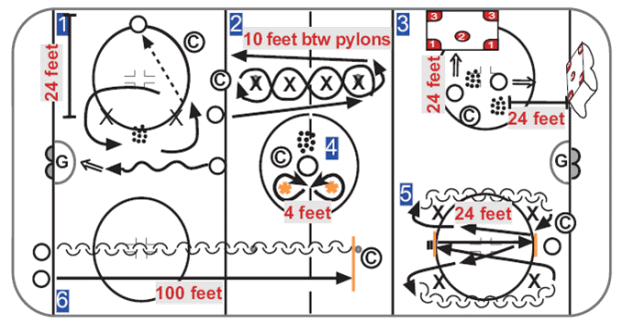
Station 1 - Forehand/Backhand Passing
1 Player starts with puck standing on edge of circle, a receiver is standing
straight across from the passer near the boards. The passer makes a total of 10
passes, 5 forehand and 5 backhand. Receivers are 24 feet from passer. At the
point where the receiver is located, place two spray paint dots on the ice 1
foot apart. The passer skates around the pylons to pick up another puck to make
another moving pass. 5 passes are made on the forehand then change direction to
make 5 passes on the backhand. The receiver is not scored for pass reception. A
successful pass is one that goes through the 2 dots on the ice.
Station 2 - Forward Weave Agility Skate
Start at the blue line, skate forward towards the far pylon and make a tight
turn around first pylon. Weave back through the pylons, making a tight turn
around the last pylon, and weave back through the pylons, making a tight turn
around the last one. Sprint back to the blue line which is both the start and
finish line. Timed both without and with a puck.
Station 3 - Shooting Accuracy
Players take 10 forehand and 10 backhand shots at a target. 3 points are awarded
for hitting the top corners, 2 points for the "five-hole," and 1 point for the
bottom corners.
Station 4 - Figure 8 Stickhandling
Each player is timed to see how long it takes to do 5 Figure 8s around
spraypainted dots. Player remains stationary, only the puck does the Figure 8s.
Station 5 - Agility Skate
Player skates forward and backward through a series of pylons and straight
lines. Tests starting and stopping, pivoting, turns, forward and backward
skating. Tested first without a puck, then with a puck.
Station 6 - Forward and Backward Speed Skate
Players skate as fast as they can 100 feet, first forwards and then backwards.
Timed both without a puck and with a puck.
Teaching Progressions
Instruction during the camp will focus on 5 main skill sets:
skating, puck control, passing/receiving, shooting, and checking. Coaches will
teach progressively, beginning with basic skills and advancing to more complex
ones. The following are sample skills that will be taught during the camp.
Skating
Forward Skating
Skating Stride
Front Start
Side Start
Two-foot stop
One-foot stop
Backward Skating
Skating Stride
Start
Two-foot stop
One-foot stop
Forward Skating
Tight turn
Crossovers
Backward Skating
Crossovers
Turning
Forward to backward
Backward to forward, heel-to-heel, crossover (Mohawk)
Backward to forward with no stop
Puck Control
Stick handling (front, side, and diagonal)
Stationary
Moving around cones
Moving around a stationary player
One-on-one in a confined space
Deking
Fake one way, go the other (forehand)
Fake one way, go the other (backhand)
Change speed
Stop and start
Curl
Stick fakes (pass or shoot)
Between stick blade and skates
Between legs
Moving around a cone
Moving around a stationary player
Moving around a moving player
Passing/Receiving
Passing Skills (in pairs, stationary and moving)
Forehand sweep pass
Backhand sweep pass
Drop pass
Back pass
Bank pass
Forehand snap pass
Backhand snap pass
Saucer forehand pass
Saucer backhand pass
Pass Reception Skills (in pairs, threes, fours, and fives; stationary and moving)
Forehand
Backhand
Extended stick
On inside of the skate
On outside of the skate
In the air with glove
In the air with stick
Shooting
Shooting Skills
Forehand sweep shot
Backhand sweep shot
Forehand snap shot
Backhand snap shot
Forehand flip shot
Backhand flip shot
Slap shot
Shooting without stopping the puck (one-timers)
Progression
Stationary, shooting against the boards
Moving, shooting against the boards
Moving, shooting against the goaltender
Shooting after receiving the pass against goaltender
Checking
Checking Skills
Angling
Poke check
Sweep check
Stick lift and stick press
Taking a check
Shoulder check
Stick lift and shoulder check
Roller check
Hip check
Diving poke check
Power Skating Drills
Shuffle (heel to heel)
Toes behind heel
Crossover
Forward lunges
Backward lunges
Inside edge (forward) Double knee bend
Inside edge (backwards)
Outside edge (forward)
Outside edge (backward)
3-step stop (forward)
3-step stop (backward)
Forward/Backward transition
C-cuts right leg forward
C-cuts left leg forward
2 leg C-cuts forward
C-cut right leg backward
C cut left leg backward
2 leg C-cut backward
Drop knee Russian hop
180 degree jump turn
360 degree jump turn
2 foot mogul / skiing
2 foot alternating slalom
Single leg alternating edges
Backward C-cuts
Backward Outside edges (cross in front)
Backward outside edges (cross behind)
Inside Edge backward around stick
Outside edge backward around stick
Figure 8 inside edge backward around stick
Figure 8 outside
Inside edges pulls around circle
Single leg suicides (forward/backward)
One leg 180 degree twist
180 degree power pull (front/back fast)
Jump stride (forward/backwards)
Stutter 2 feet / fake right turn
The Off-Season
Hockey season is over, most parents and players are beginning to
think about what, if any, plans they will make for the
off-season.
Off-season athletics, during spring and summer are very
important and key for hockey players to continue their
development. Let's not overlook the importance of the
off-season. Why stop improving? Off-season is the time to step
it up and continue the development cycle.
It is OK to play other sports after the hockey season such as
baseball or soccer. Athletes should be working on several skill
sets including multi-tasking; for example foot pattern movements
and upper body movements simultaneously.
A Squirt should not be doing the same things a Midget player
does. Midget players can begin to incorporate more off-ice
routines like plyometrics or weight training.
The Off-season is time for skill development. Work on practicing
skills all summer and train the body (age specific ) to develop
the muscle memory for the skills that will be used when games
resume.
It is best to do both on ice and off-ice workouts. Ice time is
important at a young age, but the older athlete can easier
incorporate off-ice training into skill development. Work on the
small things, like stick handling in tight areas, break down a
small segment of the game and work on just that. The best part
is many skills can be worked on off the ice. For example, you
can work on stick handling and shooting at home, in the street
or at the park. Stick handling is a great example of a skill you
can work on alone, too. The more you do it, the more comfortable
you'll be when you start playing again.
Quality execution repeated at high tempo is the key to success
in sports today. The more exposures athletes have to specific
skill sets the better equipped they will be in competition.
|